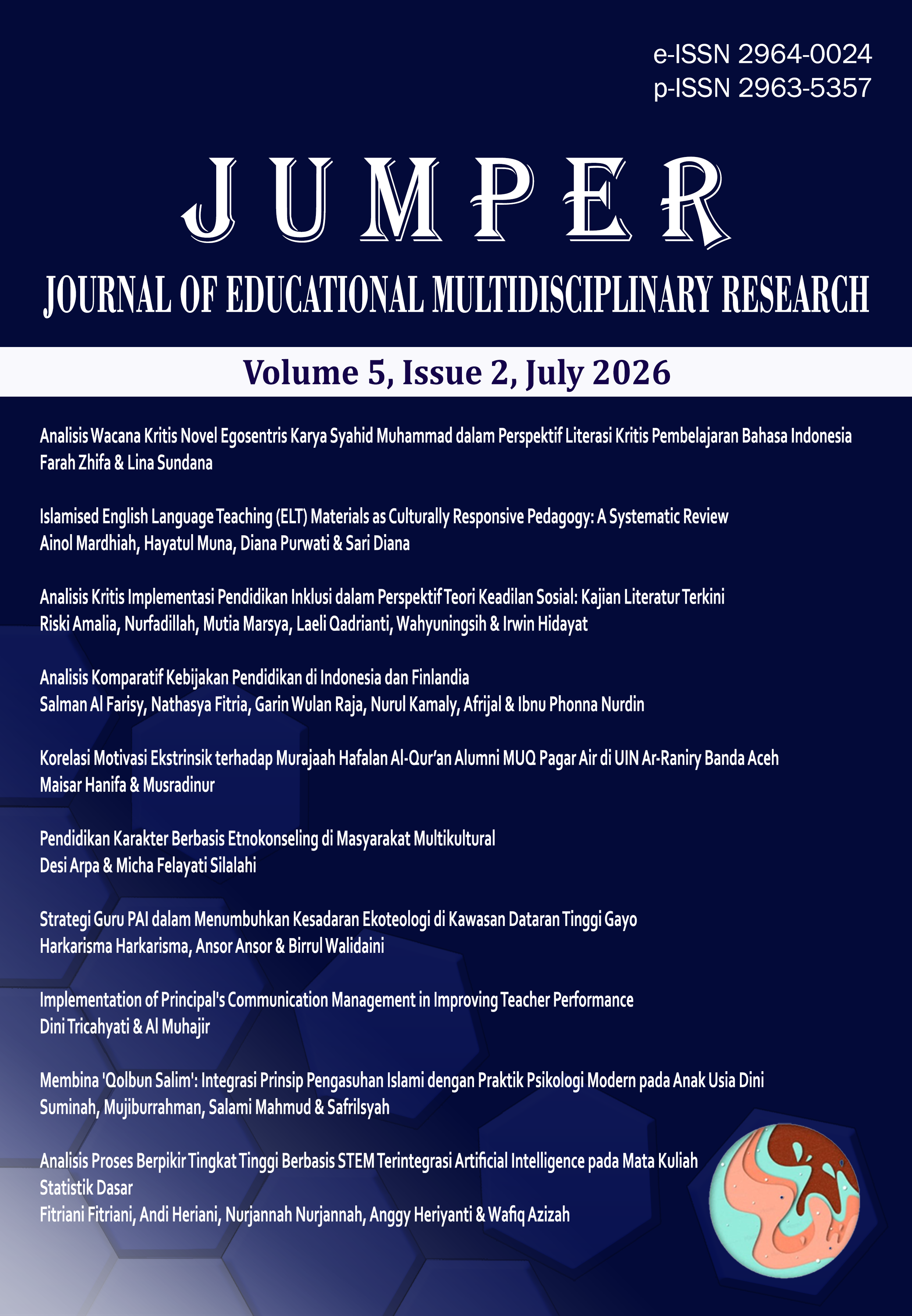
Islamised English Language Teaching (ELT) Materials as Culturally Responsive Pedagogy: A Systematic Review
DOI:
https://doi.org/10.56921/jumper.v5i2.432Kata Kunci:
Pengajaran Bahasa Inggris Keislaman, Pedagogi Responsif Budaya, Materi Pengajaran Bahasa Inggris, Nilai-nilai Islam, Tinjauan SistematisAbstrak
Tinjauan sistematis ini mengkaji konseptualisasi, manfaat pedagogis, dan tantangan materi Pengajaran Bahasa Inggris (ELT) keislaman dalam konteks pendidikan Muslim. Menggunakan kerangka kerja PRISMA, 24 peer-reviewed studi yang diterbitkan antara tahun 2022 dan 2026 diidentifikasi secara sistematis dari Google Scholar. Tinjauan ini mencakup artikel jurnal empiris tentang materi ELT keislaman atau integrasi nilai-nilai Islam ke dalam pengajaran bahasa Inggris, sementara buku, prosiding konferensi, tesis, disertasi, artikel ulasan, publikasi yang tidak dapat diakses, dan studi non-ELT dikecualikan. Kerangka waktu yang dipilih mencakup perkembangan terkini dalam pedagogi yang responsif budaya dan meningkatnya minat dalam mengkontekstualisasikan pendidikan bahasa Inggris dalam lingkungan pendidikan Muslim. Temuan menunjukkan bahwa materi ELT keislaman umumnya dipandang sebagai sumber daya yang responsif budaya yang mengintegrasikan nilai-nilai Islam, identitas peserta didik, dan konteks lokal ke dalam pembelajaran bahasa Inggris sambil tetap mendukung komunikasi global. Studi yang ditinjau menunjukkan bahwa materi ini dapat meningkatkan motivasi, keterlibatan, penegasan identitas, pengembangan karakter, dan pengalaman belajar yang kontekstual bagi siswa. Materi ini juga mendorong praktik pengajaran yang lebih reflektif dan berbasis nilai. Namun, tantangan tetap ada, seperti keterbatasan persiapan guru, kurangnya sumber daya yang kontekstual, kurikulum yang kaku, dan kekhawatiran tentang menyeimbangkan nilai-nilai lokal dengan perspektif global. Tinjauan ini menunjukkan bahwa materi pengajaran bahasa Inggris keislaman memiliki potensi besar untuk membuat pembelajaran bahasa Inggris lebih bermakna dan relevan bagi pelajar Muslim bila didukung oleh desain materi yang tepat, pelatihan guru, dan dukungan kelembagaan.
Referensi
Al-Ghazali, A. H. M., & PhD, T. M. (2005). Al-Ghazali Letter to a Disciple. Islamic Texts Society
Al-Attas (Syed.), M. N. (1991). The Concept of Education in Islam: A Framework for an Islamic Philosophy of Education. International Institute of Islamic Thought and Civilization
Albustomi, Y., Amin, M., Thohir, L., Waluyo, U., & Soepriyanti, H. (2024, June). The Teachers Perceptions and Challenges in TEYL Elementary Schools in East Lombok Indonesia | Albustomi | International Journal of Multicultural and Multireligious Understanding. https://ijmmu.com/index.php/ijmmu/article/view/5946
Al-Faruqi, I. R. (1986). Toward Islamic English: (Islamization of Knowledge Series -3). International Institute of Islamic Thought (IIIT)
Almaithalony, A. A., & Al-Jamal, D. A. (2025). Bridging Cultures: The Effect of Islamic Cultural Content on Seventh Gradersuc0u8217{ Motivation and Performance in English. International Journal of Psychological and Educational Research, 4(1). https://doi.org/10.65028/ijoper.v4i1.183
Almayez, M. (2022). Investigating the Place of Religion within the Professional Identity Construction of Two Muslim English Language Teachers in Saudi Arabia. Cogent Education, 9(1). https://doi.org/10.1080/2331186X.2022.2091632
Assalihee, M., & Boonsuk, Y. (2022). Factors Obstructing English Teaching Effectiveness: Teacher Voices from Thailanduc0u8217{s Deep South. IAFOR Journal of Education, 10(1)
Cahyo, S. D., Muslim, M. R. U., Rahman, A. N., & Pratolo, B. W. (2019). Needs analysis of Islamic-based English reading material for the Muhammadiyah junior high school. International Journal of Evaluation and Research in Education (IJERE), 8(2), 286uc0u8211{292. https://doi.org/10.11591/ijere.v8i2.18647
Coyle, D., Hood, P., & Marsh, D. (2010). Content and Language Integrated Learning. Cambridge University Press
Daneshfar, S., & Moharami, M. (2025). Iranian English Language Policy and Learneruc0u8217{s Identity Formation: A Reflective Study. Educational Research for Policy and Practice, 24(3), 347uc0u8211{360. https://doi.org/10.1007/s10671-024-09388-1
Darmayenti, D., Besral, B., & Yustina, L. S. (2021). Developing EFL religious characters and local wisdom based EFL textbook for Islamic higher education. Studies in English Language and Education, 8(1), 157uc0u8211{180. https://doi.org/10.24815/siele.v8i1.18263
Daud, W. M. N. W. (2013). Islamization of Contemporary Knowledge and the Role of the University in the Context of De-Westernization. https://www.pelitadhihin.com/product/islamization-of-contemporary-knowledge-and-the-role-of-the-university-in-the-context-of-de-westernization
Deng, C. (2023a). Why English literature is unpopular in secondary schools? A case study of Juba City Council in Four Selected schools South Sudan (CES) uc0u8211{ Juba. Research Journal of English Language and Literature (RJELAL). http://www.rjelal.com/11.3.23/191-199%20CLEMENT%20ATURJONG%20KUOT%20DENG.pdf
Deng, C. (2023b). WHY SOUTH SUDANESE LEARNERS AND LECTURES OF ENGLISH LITERATURE ARE NOT CONTRIBUTING EXTENSIVELY TO AFRICAN LITERATURE? A case study of University of Juba and four selected Schools South Sudan (CES) uc0u8211{ Juba. Research Journal of English Language and Literature (RJELAL), 11(4), 23uc0u8211{39
Deng, C. (2024). Is English Literature dying in South Sudan, if so, what is the way forward? A case study of Juba City Council in Four Selected schools South Sudan (CES) uc0u8211{ Juba. European Journal of English Language and Literature Studies, 12, 52uc0u8211{74. https://doi.org/10.37745/ejells.2013/vol12n15274
Dudley-Evans, T., & John, M. J. S. (1998). Developments in English for Specific Purposes. Cambridge University Press
Gay, G. (2021). Culturally Responsive Teaching: Ideas, Actions, and Effects. In Handbook of Urban Education (2nd ed.). Routledge
Guo, W. (2025). Application of Artificial Intelligence Empowering Ideological and Political Education in Business English Courses. International Journal of New Developments in Education, 7(9). https://doi.org/10.25236/IJNDE.2025.070909
Habiburrahim, H., Muhammad, M., Auni, L., Hafidhah, H., & Trisnawati, I. K. (2022). Integrating English subject materials into Islamic boarding school curriculum context: Insights from Aceh, Indonesia. Studies in English Language and Education, 9(2), 667uc0u8211{684. https://doi.org/10.24815/siele.v9i2.23279
Hamid, M. O., & Ali, M. M. (2023). Teaching English in the Muslim world against the backdrop of 9/11 and resurgent nationalism: A case study of Bangladeshi ELT. TESOL Quarterly, 57(3), 830uc0u8211{858. https://doi.org/10.1002/tesq.3241
Hutchinson, T., & Waters, A. (1987). English for Specific Purposes. Cambridge University Press
Iranmehr, A., Davari, H., Nourzadeh, S., & Hassani, G. (2024). English Language Education Policy and Practice in Iran and Saudi Arabia: A Comparative Study. Iranian Journal of Comparative Education, 7(1), 2805uc0u8211{2826. https://doi.org/10.22034/ijce.2023.409045.1515
Jobori, A. A., & Abdullah, M. R. (2024). Blending Beliefs: How Epistemology and Islamic Principles Shape English Teaching in the UAE. 7(2)
Karimpour, S., Jafari, R., & Nazari, M. (2022). Exploring the Role of Religious Ideology in English Language Teachersuc0u8217{ Identity Construction: A Community of Practice Perspective. The Asia-Pacific Education Researcher, 33, 3. https://doi.org/10.1007/s40299-022-00710-0
Keles, U., & Yazan, B. (2023). Representation of cultures and communities in a global ELT textbook: A diachronic content analysis. Language Teaching Research, 27, 1325uc0u8211{1346. https://doi.org/10.1177/1362168820976922
Lashari, A., Shah, W., & Memon, T. (2023). uc0u8220{Are we equal citizens?uc0u8221{: A critical discourse analysis (CDA) of language textbooks and minority faith learnersuc0u8217{ insights in Pakistan. Asia Pacific Journal of Education. https://doi.org/10.1080/02188791.2023.2270176
Liu, Y., Zhang, L. J., & May, S. (2022). Dominance of Anglo-American Cultural Representations in University English Textbooks in China: A Corpus Linguistics Analysis. Language, Culture and Curriculum, 35(1), 83uc0u8211{101. https://doi.org/10.1080/07908318.2021.1941077
Maghsoudi, M., & Khodamoradi, A. (1403). An Evaluation of the English Language Textbooks for Iranian Junior High Schools Based on the Objectives of Fundamental Reform Document of Education (FRDE). 30(2). https://en.civilica.com/doc/2192541/
Mardhiah, A., Hajar, I., Purwati, D., Muna, H., & Ariani, R. (2025). Leveraging Artificial Intelligence (AI) to Enhance Teachersuc0u8217{ Spoken English at an Islamic Boarding School. Journal of Educational Sciences, 9(6), 5163uc0u8211{5176. https://doi.org/10.31258/jes.9.6.p.5163-5176
Mazlum, F. (2022). Is English the Worlduc0u8217{s Lingua Franca or the Language of the Enemy? Choice and Age Factors in Foreign Language Policymaking in Iran. Language Policy, 21(2), 261uc0u8211{290. https://doi.org/10.1007/s10993-021-09613-0
Murwantono, D., & Muna, N. (2022). The trans-national framework and global culture for teachable American literature in Islamic higher education institutions. KEMBARA: Jurnal Keilmuan Bahasa, Sastra, Dan Pengajarannya, 8(2), 425uc0u8211{435. https://doi.org/10.22219/kembara.v8i2.19741
Nadhif, A. (2026). Mythological Narratives in Indonesian English Textbooks: Critical Discourse and Islamic Epistemological Perspectives. Islamic Research, 9(1), 28uc0u8211{41
Page, M. J., McKenzie, J. E., Bossuyt, P. M., Boutron, I., Hoffmann, T. C., Mulrow, C. D., Shamseer, L., Tetzlaff, J. M., Akl, E. A., Brennan, S. E., Chou, R., Glanville, J., Grimshaw, J. M., Hruc0u243{bjartsson, A., Lalu, M. M., Li, T., Loder, E. W., Mayo-Wilson, E., McDonald, S., uc0u8230{ Moher, D. (2021). The PRISMA 2020 statement: An updated guideline for reporting systematic reviews. BMJ, 372, n71. https://doi.org/10.1136/bmj.n71
Purwati, D., Yasin, I., Mardiah, A., & Wulandari, W. (2025). Bridging Technology and Islamic Studies: Digital Flipbook for Enhancing EFL Learnersuc0u8217{ Public Speaking Skills in Islamic Higher Education. Journal of Educational Sciences, 9(5), 4388uc0u8211{4402. https://doi.org/10.31258/jes.9.5.p.4388-4402
R, S. M., & Maulidiyah, N. (2026). INTEGRATING ISLAMIC VALUES INTO ENGLISH LEARNING: PERSPECTIVES AND PRACTICES AT MA DARUL ILMI BANJARBARU. ENGLISH JOURNAL, 20(1), 88uc0u8211{98. https://doi.org/10.32832/english.v20i1.23131
Rahmatika, L. A., & Izzah, L. I. (2024). Integrating Islamic Values in English Learning through Islamic Stories: Studentsuc0u8217{ Perspective. JL3T (Journal of Linguistics, Literature and Language Teaching), 10(2), 222uc0u8211{232. https://doi.org/10.32505/jl3t.v10i2.9287
Solehan, S., Harahap, A., & Diani, I. (2021). Needs Analysis of English Materials for Islamic Economics Students. SALTeL Journal (Southeast Asia Language Teaching and Learning), 4(2), 1uc0u8211{6. https://doi.org/10.35307/saltel.v4i2.75
Tomlinson, B. (2011). Materials Development in Language Teaching. Cambridge University Press
Yulianti, D. B., Suryaman, M., & Jamilah. (2025). ISLAMIC VALUE INTEGRATION IN EFL SPEAKING CLASSES: A LEARNING DESIGN FOR A PROJECT-BASED LEARNING MODEL.. https://doi.org/10.18623/rvd.v22.n2.3254
Unduhan
Diterbitkan
Cara Mengutip
Terbitan
Bagian
Lisensi
Hak Cipta (c) 2026 Ainol Mardhiah, Hayatul Muna, Diana Purwati, Sari Diana

Artikel ini berlisensiCreative Commons Attribution-ShareAlike 4.0 International License.